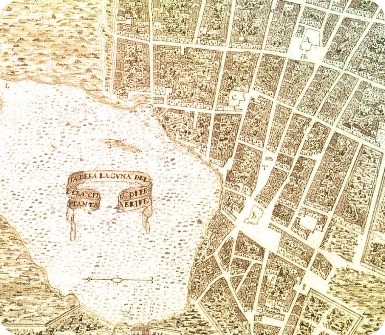
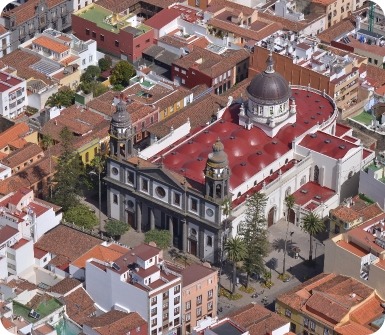
In 1588, Italian engineer Leonardo Torriani drew up the first map of the city, at least the oldest one that has been preserved. What we now know as the historic centre, as can be seen on this map, had already been defined at that time: the small cluster of disorderly houses to the west of La Concepción; the geometric layout to the east, stretching from this church to Villa de Abajo via three main streets, Herradores, Obispo Rey Redondo and San Agustín; the magical triangle formed by these streets, with Nava and Grimón and the Plaza del Adelantado as its corners… The Laguna that can be seen today is the same one that the Adelantado imagined when he looked out over the valley from the nearby hills.
As buildings and squares were erected, following this checkerboard principle, the first unfortified colonial city, a city-territory, began to emerge from the vegetation. Why build walls when the surrounding mountains already protect the city? The privileged location of La Laguna, in a valley five hundred metres above sea level, made possible the birth of a new concept of settlement, a model that would henceforth also be applied in many colonial enclaves in the New World.