What we now know as San Cristóbal de La Laguna was part of the kingdom or Menceyato of Tegueste, in the area known by the aborigines as Aguere. It was a strategic location even before the conquest of Tenerife, where people would come seasonally with their livestock because it was fertile land, surrounded by mountains and with a small lagoon.

Aguere was the scene of the last battle between the Castilian troops, under the command of Don Alonso Fernández de Lugo, and the indigenous people, and where the definitive conquest of the island was decided. The victory, after defeating Mencey Bencomo and his brother Tinguaro in 1496, definitively incorporated Tenerife into the Crown of Castile. It took place on San Cristóbal’s Day, which gave the city its founding name and led to its patronage alongside San Miguel, the patron saint venerated by Don Alonso.

To commemorate these historical events, the chapels of Gracia and San Cristóbal and the convent of San Miguel de las Victorias were built.

Don Alonso Fernández de Lugo obtained from the crown (the Catholic Monarchs), in return for the conquest, the title of Adelantado and the governorship of the territories. He held full rights to administer justice, appoint various administrative, judicial and military officials, allocate land, issue ordinances and head the Cabildo (town council). The first chapter meeting was held on 20 October 1497 and for a long time it was the main and only governing body.

The succession of Fernández de Lugo’s descendants to the position led to San Cristóbal de La Laguna becoming known by this nickname, as the city of the Adelantados.

Throughout the 16th century, the town developed into two distinct population centres, which emerged in different ways. The first settlement chosen by the Adelantado, around the Parish Church of Nuestra Señora de la Concepción, was characterised by its lack of a planned urban layout. It consisted of just a few stone houses with thatched roofs, which formed a small hamlet. Around 1500, a second, more rationalised settlement emerged, promoting the settlement of the population in the south of the territory, starting from Santo Espíritu (Convent of San Agustín).

The two villages, La Villa Veccia or Villa de Arriba and Villa de Abajo, eventually merged. A new city was founded, based on Renaissance concepts using mathematical formulas, and its streets were laid out using navigational instruments. A grid-like urban system, formed by straight streets that make up blocks. Its layout is the first example of a non-fortified city, an example of a City of Peace, a city-territory that used its own natural borders to delimit itself: the Barranco de Chamarta and Barranco de las Carnicerías or Gonzalianes ravines, as well as the lagoon itself and the mountains that surround it, were its natural defensive systems. As an inland city on the island, it was also protected from the constant pirate attacks that threatened the Canary Islands’ coastline. This model would later be exported to American cities.

In the Villa de Abajo, built in the Castilian style, stands the main square, around which are located the houses of the Adelantado, the Justice and the Government of the Island. Queen Juana I of Castile issued a Royal Decree on 3 February 1510, granting the town its title and coat of arms. This coat of arms features the Archangel Saint Michael with military attributes; below the saint, the castle and rampant lion of the kingdoms of Castile and León, guarding a flaming mountain representing El Teide, surrounded by the sea. The coat of arms is completed by the inscription: MichaelArcángel beni in aditorium populo dey Tenerife me fecit, segung.

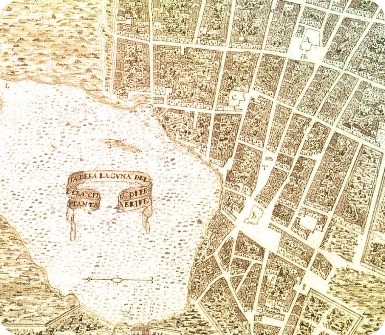
Throughout the century, urban growth occurred rapidly, to the point that in 1588, military engineer Leonardo Torriani, sent to the islands by Philip II to improve their defences and describe them, drew a map of Villa de La Laguna, which already showed three convents, six chapels, the Cabildo, churches, two hospitals, squares and streets, which can still be seen today. The description refers to it as the largest city built after the Conquest. The rapid growth of the town led Charles I to grant it the title of City on 20 January 1531 as well as that of Noble and Loyal History on 8 September 1534.

In the 17th century, foreign trade with the Netherlands, England and the Indies received a significant boost through the consolidation of local viticulture. Tegueste, La Punta del Hidalgo, Geneto and Taganana were the main areas of cultivation. As a result, a commercial bourgeoisie emerged that sought a prominent place in society, traditionally characterised by its agricultural origins.

In the middle of the century, the uncontrolled production of these wine products led to the loss of land for growing cereals and pasture for livestock. The shortage of bread led to intervention by the City Council, which was forced to lower the price of grain and regulate the organisation of cultivation areas through ordinances.

The 18th century was one of the most prosperous periods of socio-economic change experienced by the Canary Islands and La Laguna. It was the Age of Enlightenment, a time when education, administration, agriculture, and the arts were promoted, and the islands experienced an economic revival through free trade.

Under the umbrella of free thought and critical thinking about the country, cultured meetings with a reformist intent began to spring up, questioning the social, religious, cultural and economic aspects of the island. In La Laguna, the Tertulia de Nava was the most important. Its driving force was Tomás Lino de Nava Grimón y Porlier (1734-1779), a man of great intellectual curiosity and extensive political responsibilities. His successor, Alonso de Nava-Grimón y Benítez de Lugo (1759-1832), promoted the founding of the Royal Economic Society of Friends of the Country of Tenerife (1777) and the University of San Fernando (1792).

From the mid-1800s onwards, La Laguna began to lose power to Santa Cruz, due to the relocation of the Captains General and the growth of the Port of Santa Cruz. With the new century came the separation of the diocese of Tenerife from that of Las Palmas, and La Laguna received the Bull of Pius VII for the election of the new Bishopric on 1 February 1819.

The War of Independence and the creation of an alternative government such as the Supreme Junta of the Canary Islands set the political tone in La Laguna. A new period of instability began, notable for the administrative reorganisation that followed the Cortes of Cádiz (1812) and the loss of the Canary Islands’ status as the sole capital (1833).

At the end of the 19th century, La Laguna saw a significant improvement in its transport links. From a public perspective, tree-lined boulevards appeared on the outskirts of the city, and streets and squares were paved, but perhaps the most significant work was the improvement of the road to Santa Cruz, the only route between the current capital and the rest of the island.

In 1901, the tramway began operating, and by 1911, its lines had been extended from Santa Cruz to Tacoronte.

From a social perspective, the late 19th and early 20th centuries saw several waves of emigration to the Americas, particularly to Cuba and Venezuela, with La Laguna being one of the towns most affected by the decline in its population.

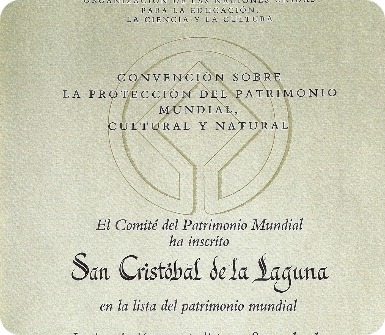
The historical ups and downs of San Cristóbal de la Laguna have not produced any substantial changes in its buildings or urban layout. The coexistence of old Mudejar-style mansions, ancient convents, eclectic architecture and new urban development plans characterise the most contemporary period; and led to the UNESCO World Heritage Committee recognising the unique and authentic values of San Cristóbal de La Laguna on 2 December 1999 in Marrakech, awarding it the title of World Heritage Site.

The Torriani Plan

Historical Overview

World Heritage City (UNESCO)

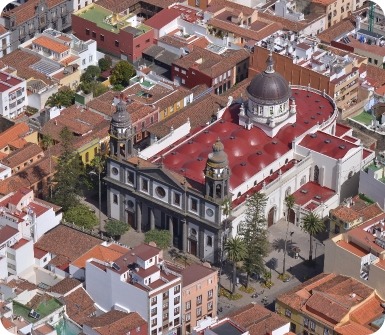
Notable buildings in the historic complex