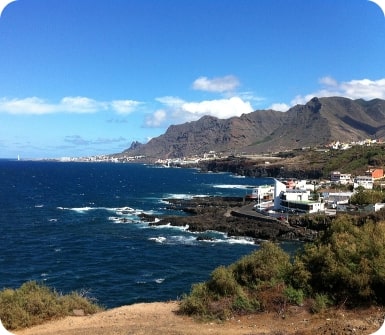
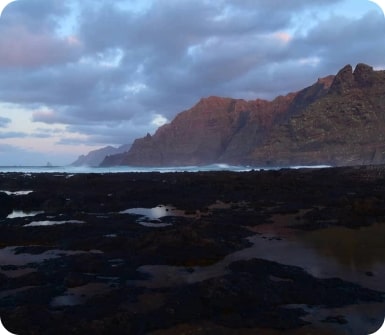
On the northeast coast of Tenerife, between the green Anaga mountains and the blue ocean, lie the villages of Bajamar and Punta del Hidalgo.

Although both towns are important tourist centres within the municipality of La Laguna, they have managed to preserve the tranquillity and charm of small coastal villages, where agriculture and fishing continue to be significant elements of their economy and culture.

The landscape of this area is accompanied by a stable spring-like climate with an average annual temperature of 21 degrees Celsius, inviting visitors to enjoy outdoor activities and the sea. These towns offer many possibilities: sandy or rocky beaches and pools that are ideal places to enjoy swimming in the sea and sunbathing; peaceful walks along the seashore; or sports such as fishing, surfing or diving. Not to mention the trails that start from any of them and lead into the Anaga Rural Park.

These are ideal locations for people who value health and wellbeing-related offerings when choosing their holiday destination.

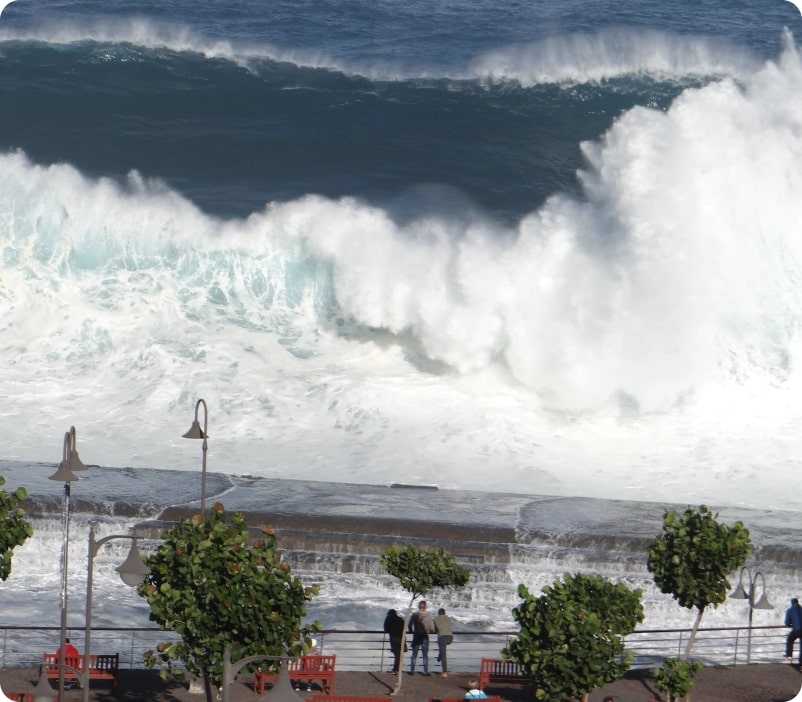
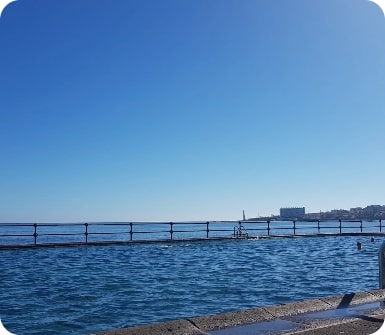
Beaches such as Troche, San Juan and El Arenal, and swimming pools such as Bajamar and El Arenisco, where you can enjoy a peaceful swim in this area of strong waves, are some of its attractions.

The interior of the villages offers charming spots that tell us about their evolution and remind us of memorable figures from the area. The Sebastián Ramos square, the San Juanito and Carmen chapels in Punta del Hidalgo, and the Gran Poder de Dios and San Juan chapels in Bajamar are some of the places we recommend visiting.

There are also several trails that start from Punta del Hidalgo and Bajamar and lead into the mountains and valleys of Anaga. These trails immerse us in the landscape of one of the oldest geological areas on the island and take us to hamlets such as Chinamada and Bejía, which were part of the municipality of Punta del Hidalgo in the 19th century.

And to satisfy your appetite, the area also offers numerous restaurants where you can savour the characteristic dishes of traditional cuisine. Fresh fish and seafood feature prominently on a varied menu with the flavour of fishing villages.

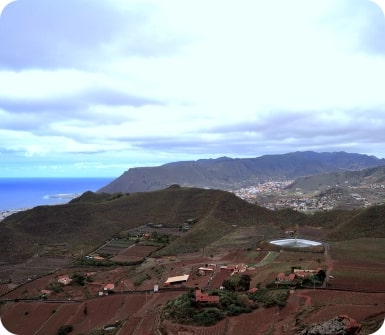
This area is a showcase for an enormous variety of landscapes that coexist within a limited space. From the coast to the summit, pools, rocks, arid areas and evergreen forests intermingle.

The coasts of Bajamar and Punta del Hidalgo stand out for their wide platform formed by rocks and pools, generally shallow, which are exposed at low tide. These pools are small worlds teeming with life, where fish fry and molluscs serve as food for different species of birds that visit the area, mainly in winter, either to stay or as a stopover on their migratory journeys.

Download coastal area map

A little further up, the dry domains of cardoons and tabaibas begin, true specialists in making the most of the scarce moisture on the lower slopes of the ravines.

In the upper part of Bajamar, some dragon trees intermingle with the palm grove, forming one of the best-preserved examples of thermophilic forest remaining on the island. This forest, which once covered the midlands of the islands, has been reduced to small copses in areas that are difficult to access, such as these.

The landscape of the peaks of the Anaga massif is striking for its deep ravines and challenging rock formations. This rugged environment has served as a refuge for Monteverde, a remnant of the forests that covered southern Europe and northern Africa in the Tertiary Period.

Before the conquest, Punta del Hidalgo was a domain independent from the other menceyatos, ruled by Aguahuco, son of Mencey Tinerfe, and later inherited by his son Zebenzuí.

After the conquest, the population gathered in the neighbourhoods of El Homicián and La Hoya, initially formed by small hamlets whose inhabitants were mainly engaged in agriculture and fishing.

Bajamar

The Barranquera

Jóver

Punta del Hidalgo